$9 billion school construction bond moves toward November ballot
Credit: Flickr
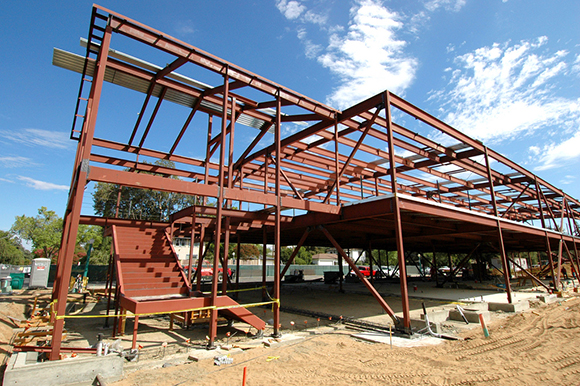 Credit: Flickr
(Update: On Th, the total Assembly passed AB 2235 by a vote of 75-0, sending it to the Senate for consideration.)
The Assembly Appropriations Commission has finally put a dollar figure to a schoolhouse structure bond measure that it wants to identify on the November election: $9 billion.
Voter approval to issue new 30-year construction bonds would be the outset state financing for facilities for M-12 schools and higher educational activity since voters passed a $10.4 billion school construction in 2006. Of the proposed $9 billion, $vi billion would go for G-12 facilities modernization (separate $three.25 billion for modernization, $2.25 billion for new structure and $500 million for charter school facilities); $2 billion for community college facilities and $500 meg each for the University of California and California State University. According to an assay by the Appropriations Committee, the bail would run into a small-scale piece of the tens of billions in new or renovated building needs that K-12 districts and higher education systems say they need.
Last Fri, with a 16-0 vote (with Republican gubernatorial candidate Tim Donnelly, R-Hisperia abstaining), the commission passed Assembly Bill 2235, co-sponsored by Assemblywoman Joan Buchanan (D-Alamo), who chairs the Assembly Education Commission, and Assemblyman Curt Hagman, R-Chino Hills. Since 1998, country voters have approved $35 billion for school construction that has cost the country $two.four billion in almanac debt service, co-ordinate to the Department of Finance. Withal, funds in the School Facility Program, which regulates how funds are distributed, are now depleted.
As with past bond measures, school districts would take to pony upwards their own money to get state funding. For upgrading buildings, districts must contribute xl percent of the cost. For new construction, it'southward a fifty-50 carve up with the land.
At that place is no statewide inventory of school districts' facilities, merely Buchanan estimates that the proposed bail mensurate would take intendance of districts' needs for virtually five years. Some of the money would help articulate out the backlog of districts that accept passed local bonds with the expectation of matching coin. "I become calls constantly from districts that say they would have to cut back on projects they need" without country funding, she said. "There are 50-year-one-time schools in need of repair and schools without technology. The chore is not washed all the same."
With bipartisan back up in the Assembly and a coalition of the edifice trades unions, the construction industry and business organisation and education groups behind a new school bail, Buchanan is confident of getting a two-thirds majority approving in the Legislature to put the measure on the ballot.
Winning Gov. Jerry Brown's bankroll, however, could prove harder. In the state budget he proposed in January, Brownish defended $188 one thousand thousand of ane-time money to reimburse districts for emergency repairs. At the same time, he criticized the current system of funding G-12 construction and indicated he was re-evaluating schools facilities funding, "including consideration of what role, if any, the country should play in the future of school facilities funding" (see page 7 of K-12 budget summary). He said the current system of facilities approving is too complex and does not allow districts enough flexibility for non-standard building and classroom designs. He questioned the first-come, beginning-served system of funding, saying it favors large districts. And he said the current system may encourage districts to overstate their space needs.
Buchanan said that she has met with Department of Finance officials and is open to clarifying the nib to accost issues that Brownish raised. The governor hasn't indicated whether he would support a bond of any size this year, she said.
Buchanan said her bill does deal with several bug the governor raised. Districts would accept to re-establish their eligibility past recalculating their building needs, using updated omnipresence projections and accounting for all new structure and renovations since the last state bond measure. And she said the neb would require that the Office of Schoolhouse Construction recommend regulations providing school districts with flexibility in designing facilities.
AB 2235 does not suggest giving funding priority to school districts with large numbers of high-needs students. However, it does allow for full country funding of facilities in financially stressed districts that lack the capacity to accept on additional debt.
To get more reports like this ane, click here to sign up for EdSource's no-toll daily e-mail on latest developments in teaching.
chandlerhamithen36.blogspot.com
Source: https://edsource.org/2014/9-billion-school-construction-bond-moves-toward-november-ballot/62621
0 Response to "$9 billion school construction bond moves toward November ballot"
Post a Comment