What it takes to be Asia’s Best Restaurant: Inside the workings of Odette
The night Odette was named Asia's All-time Restaurant 2019, chef Julien Royer and general manager Steven Stonemason did what most winners do – they celebrated with more than a few drinks. "But it was nothing as well wild," Royer was quick to point out. "We had to catch the ferry (out of Macau) early on the adjacent forenoon. Nosotros arrived in Singapore at 10pm and went back to the eatery to drinkable champagne with the team."
Every bit historic as the win is – Odette is the first eating place from Singapore to earn the crown – an honour in the eatery business is just that: A rewarding affirmation from a punishing industry for the hard work and long hours that anybody puts in. By 9am the next day, it was business as usual.
It's a hustle the team knows well. Long before it was Asia's Best Eating place, Odette has had the honour of being Singapore's busiest fine dining establishment. Since it opened its doors almost four years ago, it hasn't gone a solar day without a warm seat in the house.
"With rankings and awards, you must accept that you will win and you will lose. I know that all that is ephemeral," Royer said when asked about the bellboy pressure level that comes with the prestigious prize. "What matters is that nosotros must be doing something right considering the restaurant has been fully booked since mean solar day i. That is the near priceless to us. That is what we constantly work for."
INSIDE THE KITCHEN
Royer may exist Odette's main homo, only similar all good leaders, he is backed by a devoted team of about 25 full-time employees. A repast service here is alike to a world-class trip the light fantastic performance that exudes effortless grace and rhythm, from the warm smiles that greet guests every bit they enter, right downwardly to the spotless gleam of a paper-thin water glass that has been polished thrice.
Behind their balletic fluidity is the ever-unfurling toil of physical labour, precision cooking and precious camaraderie. The team works in collective harmony, each member dependant on the other for the eatery's success. They exercise this 16 hours a mean solar day, v days a week.
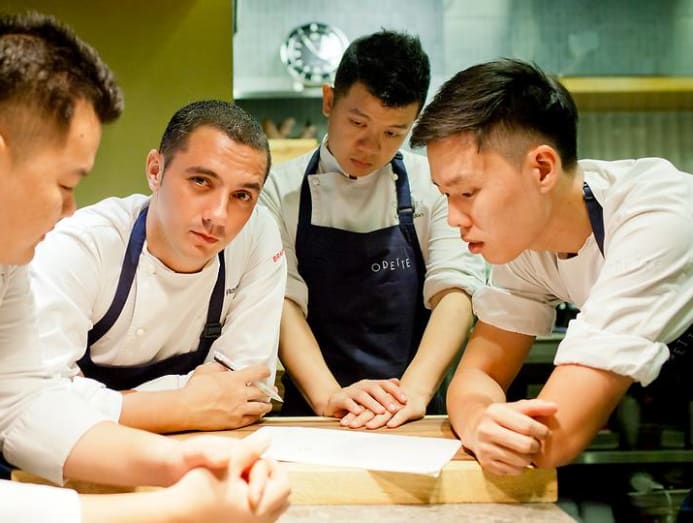
Royer describes his kitchen'southward residuum as "fragile" and leans upon his senior sous chefs Adam Wan and Levin Lau, and sous chef Sheng Xiong to ensure that the equilibrium never wavers.
"I brand all my decisions about hiring in the kitchen with them," said Royer. "If ane of united states has doubts about the person, I don't hire him or her. This fragile balance is key to our success considering everyone hither must want to shine as a team, not every bit an individual. Equally soon as someone is unhappy, you tin tell." Fifty-fifty at this level of cooking, the adage that a happy cook produces better food remains sound.
The work they do is repetitive and exacting. The complex dishes change daily, depending largely on the produce and the team'south imagination. Royer prefers to buy ingredients in small quantities, which keeps the team creative and prevents waste. One of the perks of existence a restaurant renowned for its delicious ingenuity is that every day, distributors from all over the globe stream in with produce they hope the kitchen will buy. Today, information technology was wild asparagus from Italian republic; yesterday, it was jars of honey from the Philippines.
The team literally hits the ground running from the minute they make it at their stations at viii.30am. For Royer, who typically arrives a trivial later on at 9am, the first order of concern is greeting and chatting with every member of his restaurant. "It'south very important to take a close human relationship with everyone here," he reiterated.
"What matters is that we must be doing something correct because the restaurant has been fully booked since day one. That is the almost priceless to us. That is what we constantly work for." – Julien Royer
Dejeuner is the commencement priority and a complicated exercise since guests are given the option of a iv, six or 8-class menu with a option of dishes for diverse courses. There's also a vegetarian bill of fare and the fact that things don't always become to plan.
"A lot of what we cook depends on the timing of the deliveries," Royer added. "For example, today, I wanted to brand a scallop with konbu and nage with mint, but the scallops came tardily, so we are using crabmeat instead. We also wanted to practice morels with asparagus and sweetbread, just at present the morels are coming tomorrow. Every day we have to deal with this balance, but I dear it. I think this is the mode to do it. When you don't club a lot of ingredients, you don't finish up wasting and there is no spoilage."
READ> How Singapore'due south restauranteurs are rising to the challenges of sustainability
On an easy afternoon, the final guests exit the dining room at iii.30pm. Frequently, however, diners tend to stay far longer. The day before this interview, the concluding dejeuner invitee left at 5.30pm.
FRONT AND Middle
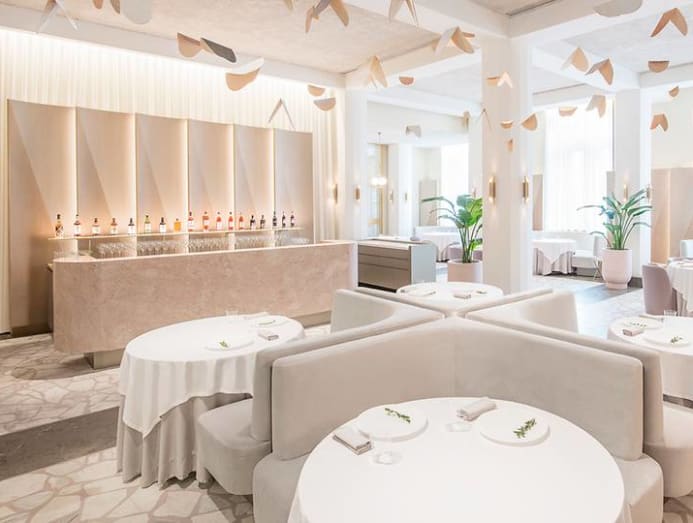
The hierarchy in the dining room, called the front-of-house in industry parlance, mirrors that of the kitchen. At the top is full general manager Steven Mason, who is aided past his team of about fourteen banana managers, head waiters, sommeliers, hostesses and waiters. The service they each purvey is built around providing a personalised experience and the ability to read a guest.
"Nosotros teach people that when they go to a table, they must run across what the tabular array wants. If I start explaining the dish and they're not interested or focused, then I back off and leave them to their food. If we see them examining the bottom of a plate or drinking glass, we tell them where the glass is from or who made the plate," explained Mason.
"If one of us has doubts about [a] person, I don't rent him or her. This fragile balance is key to our success considering everyone here must desire to smooth as a team, non every bit an individual." – Julien Royer
Much of the front-of-house work comprises general labour. From the minute the showtime shift begins at 10am, the team mops floors, cleans tables and windows, prepares the cheese and drinks trolleys, polishes plates and glasses, and adjusts lights to ensure they are angled just so. 2 hostesses tend to the over 200 emails that the eating place receives every solar day.
After the last tiffin guest leaves, the team takes about hour and a half to fix up for dinner before they have their only pause of the 24-hour interval. During this 40-minute window, the entire staff shares a meal together. "Iii times a week nosotros cook and three times a week, on big delivery days, we buy food like chicken rice or noodles," said Royer.
"We spend and then much time together and that makes usa family unit," added Stonemason. "Nosotros ever attempt to create unity with people. Like family, we may take a fight today, but tomorrow nosotros're back at information technology.
"This is non an environment that'southward easy to piece of work in – we are always busy and yous only get 30 to 40 minutes to get something to eat and then get back to making sure people are happy and grinning and comfortable. So nosotros value our people. This is what hospitality is about, not just for the guest, only for our staff too."
THE Center OF THE PEOPLE
Like in any concern, people form the cornerstone of Odette's success. Not only must its managers ensure that employees remain happy and motivated, there are also hundreds of customers whose myriad preferences must exist considered. The profiles of 450 regular diners are recorded in nuanced detail, be information technology special diets, allergies, h2o, seating or any other idiosyncratic preferences.
"The hardest and most important thing is that everyone who comes to the restaurant has a different expectation, and we have to ensure we adhere to what they want," said Bricklayer. "With Julien, yous're always working in a style that's changing and it tin can be a challenge to keep my team smiling and positive. And then I go far a point to learn about them, take fun and laugh. We talk about how we tin can make things better rather than me telling them how things tin be made amend."
"We spend and then much time together and that makes us family. Like family, we may take a fight today, merely tomorrow we're dorsum at it." – Steven Stonemason
It is obvious that Mason brings the pragmatism to Royer's passion. "Julien always wants things immediately and I often have to tell him to slow down," Mason said, giving Royer a jocular side eye. "Similar nosotros were just talking virtually how nosotros can change the bill and Julien is like, 'alter it tonight!' But I take to understand what's the best manner to practice it and what the procedure is going to be."
How does Royer think information technology'southward going to get changed, I ask? "He doesn't know!" replied Bricklayer, and they both break out in laughter.
Information technology is clear both men share a tight bail – they speak in the kind of shorthand that expert friends share, shoot each other knowing looks throughout the chat, and even finish each other's sentences. They practice, after all, spend more time together than they practice with their wives.
Their shared commitment to the eating place's success shows in the accolades, the constantly busy dining room, and high charge per unit of staff retentivity. The average rank and file employee stays with Odette for between 18 months to 2 years, while some similar senior sous chef Levin Lau accept worked with Royer for the final decade. This is impressive, as employee memory is something restaurants oftentimes grapple with, peculiarly with the kind of hours that Odette demands.
Asia'due south Best Restaurant or not, the pressure that comes with existence at the top of the industry remains because they intrinsically originate from within. "We never permit it to go like shooting fish in a barrel for ourselves. The idea is always to go forward," said Mason. "We are, offset and foremost, a business. What's more than important than any award is having a full, profitable eating house night later on night."
Royer nods in understanding. "I call back we can e'er do better than the day earlier."
0 Response to "What it takes to be Asia’s Best Restaurant: Inside the workings of Odette"
Post a Comment